Skip to the sefer
The Eighthהשמיני

Reading settings

Type size
Line width
The EighthGate 1 of 1627 minutes

Before Eight There Must Be Seven

שֶׁבַע

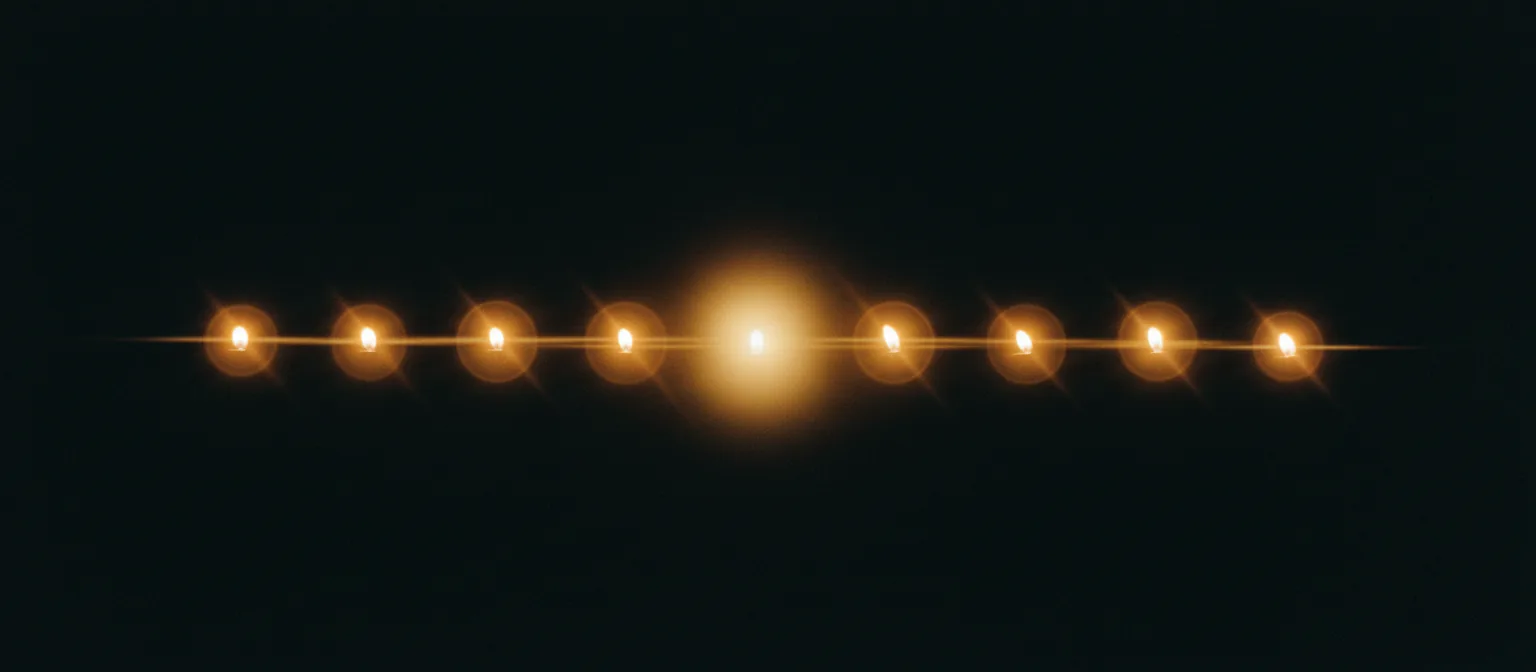
A row of candle-gold lights across deep darkness, one of them larger and surrounding the rest.
Section 1 of 501

Petichah

There are numbers by which things are counted, and there are numbers by which reality is disclosed.

One counts because there are objects before him: one stone, two stones, seven branches, eight days. But Torah sometimes numbers differently. A number becomes an architecture. It tells us not merely how many things stand before us, but what kind of world we have entered.

Seven is such a number.

And eight is another.

Seven is so deeply written into creation that one can almost mistake it for existence itself. Six days unfold and the seventh gathers them into Shabbos. Seven years complete the Shemittah cycle. Seven Shemittos lead towards Yovel. Seven lower middos form the emotional order of the sefirot. Seven branches rise from the Menorah. Seven weeks are counted between Pesach and Shavuos. Sukkos moves through seven days. The world lives in seven because seven describes the completed order of a creation capable of receiving holiness without ceasing to be creation.

Seven is not deficient.

Seven is magnificent.

Seven is the world brought to perfection according to its measure.

And precisely there the question begins.

What comes after perfection?

Not improvement.

If something is complete, adding another unit of the same kind does not reveal a new essence. It enlarges quantity but does not cross a boundary.

Torah therefore introduces eight at moments when the boundary itself changes.

The child enters the covenant of Avraham on the eighth day.

The Mishkan reaches its revelatory beginning on the eighth day.

After seven days of Sukkos comes Shemini Atzeres.

The harp associated with the days of Moshiach is described by Chazal as possessing eight strings.

Moshiach himself appears among the “שמונה נסיכי אדם”, the eight princes of man.

Eight returns again and again where completion opens into something completion could not generate from within itself.

The language of Chassidus is למעלה מן הטבע, beyond the natural order.

But this must be understood with care.

Eight does not mean that Torah finally grows tired of the world.

Eight does not mean the finite has failed.

Eight is not holiness abandoning nature because nature proved inadequate.

The deeper secret is the opposite.

The Eighth reveals that the natural order was constructed from the beginning as a vessel for that which exceeds it.

Seven is the house.

Eight is the Presence for whom the house was built.

Seven builds the vessel.

Eight discloses what the vessel was secretly carrying.

Seven completes creation according to its revealed grammar.

Eight reveals the intention that preceded the grammar.

And this is where the question of the eighth generation begins.

Not first as chronology.

As Torah.

Not first as succession.

As structure.

Not first as a claim about a person.

As the hidden logic of what follows seven.

Because if the Alter Rebbe begins a seven-generation movement, and if the seventh generation understands itself explicitly as the generation whose avodah is to complete the drawing of the Shechinah into the lowest world, then Torah permits us to ask a question that is not small.

What does eight mean after such a seven?

What can follow a generation whose very identity is completion?

What comes after the Shechinah has been brought down?

The answer proposed here is a chiddush, not an institutional claim and not a replacement for anything received in Chabad tradition.

The seventh completes descent.

The eighth begins revelation from within the place reached.

The seventh brings the Shechinah into the dwelling.

The eighth is the dwelling discovering Who has been dwelling inside it all along.

And that is why the deepest name of the Eighth is Moshiach.

ISection 2 of 501

Before Eight There Must Be Seven

One cannot understand eight by rushing past seven.

Seven is not a prison from which the mystic longs to escape. Seven is creation when creation has become worthy of its Creator.

The first chapter of Bereishis builds six days through distinction. Light is separated from darkness. Upper waters from lower waters. Land from sea. Species emerge. Luminaries mark time. Living creatures inhabit their domains. Humanity appears within a structured cosmos.

Then Torah says:

“ויכל אלקים ביום השביעי מלאכתו אשר עשה.”

G-d completed on the seventh day the work that He had made.

The seventh is therefore not simply the final item in a sequence.

It is the day in which sequence acquires wholeness.

Six describes expansion.

Seven describes inward gathering.

Six goes outward.

Seven knows what the outward movement was for.

A week does not merely stop at Shabbos. It arrives there.

Everything done during the six days is drawn into menuchah.

This is why seven corresponds so naturally to the lower seven sefirot: Chesed, Gevurah, Tiferes, Netzach, Hod, Yesod and Malchus.

They are not random spiritual attributes.

They form the range through which Divine vitality becomes inhabitable in worlds.

Chesed expands.

Gevurah measures.

Tiferes integrates.

Netzach drives.

Hod yields and articulates.

Yesod transmits.

Malchus receives and manifests.

The movement terminates in Malchus because revelation must finally become somewhere.

A king without a kingdom has kingship only in potential.

A word never spoken remains hidden in thought.

A light never received has not yet become a dwelling.

The descent into Malchus is therefore not the unfortunate distance of Divine light from its source.

It is the purpose toward which the upper structure is moving.

Seven reaches the lowest place.

That is its greatness.

And the Torah does not ask us to despise the lowest place after arriving there.

It asks us to discover why everything came down.

IISection 3 of 501

The Seventh Is Beloved Because It Completes What the First Began

When the Rebbe delivered the first maamar of his nesius, Basi LeGani, he located the seventh Chabad generation inside an ancient Midrashic structure.

The Ikar Shechinah originally dwelt below.

Through seven great disruptions, Divine Presence withdrew through successive heavens.

Then came seven tzaddikim who brought it downward again.

Avraham began.

Yitzchak continued.

Yaakov.

Levi.

Kehos.

Amram.

Moshe.

And Moshe, the seventh, brought the Shechinah back to earth.

Hence the expression:

“כל השביעין חביבין.”

“All sevenths are cherished.”

But the Rebbe does not let the seventh become self-enclosed.

The seventh is beloved because it is seventh from the first.

Moshe's place is inseparable from Avraham.

The culmination reveals the beginning.

The end does not compete with the root.

It proves what was hidden in the root.

The Rebbe then maps this upon the generations of Chabad beginning with the Alter Rebbe.

The Alter Rebbe is first.

The Mitteler Rebbe follows.

The Tzemach Tzedek.

The Rebbe Maharash.

The Rebbe Rashab.

The Frierdiker Rebbe.

Then the seventh generation.

Its purpose is not defined as creating a detached spiritual movement. It is the completion of a descent begun long before it.

The Shechinah below.

The essential Divine Presence where created consciousness experiences itself as furthest from G-d.

Not heaven perfected.

Earth made transparent.

Not angels elevated.

Flesh sanctified.

Not spiritual worlds admired.

This world made a dwelling.

That is the axis upon which the seventh stands.

And this tells us something decisive about the eighth.

If seven completes the downward movement, eight cannot simply be “further down”.

There is nowhere beneath the tachton in the logic of dirah betachtonim.

The lowest has been reached.

The question changes.

Not: how much further can light descend?

But: what happens when the recipient begins to answer?

IIISection 4 of 501

The Hidden Turn From Hamshachah to Gilui

Here the distinction between seven and eight becomes more precise.

Seven is hamshachah.

Drawing down.

Eight is gilui.

Disclosure.

This does not mean that revelation was absent from the seventh. Nor does it mean that drawing down ceases in the eighth. The distinction concerns predominance.

The work of seven is to make the lowest world capable of receiving.

The secret of eight is that what was received begins to speak from within the receiver.

The direction turns.

Until now, heaven has been teaching earth.

In the Eighth, earth begins revealing what heaven placed inside it.

This is not rebellion from below.

It is or chozer.

Returning light.

The Kabbalistic imagination knows that light does not fulfil itself by descent alone. A movement from above to below has not yet become a relationship merely because it reached its recipient. The recipient must receive, transform, and return.

A blessing is given.

Then comes Amen.

Torah descends.

Then comes tefillah rising upward.

Rain falls.

Then earth produces fruit.

Wisdom enters a student.

Then the student asks the question through which a depth hidden even in the teacher emerges.

Seed enters earth.

The earth does not hand the seed back unchanged.

It gives forth life.

The receiver is therefore not merely the endpoint of transmission.

The receiver is the beginning of transformation.

This pattern lies deep within the attached framework: the descent to the lowest place is not complete until a return movement arises from that lowest place, and the Messianic future is treated as the closing of that circuit rather than abandonment of the structure that made it possible.

Now apply the same architecture to the generations.

The first begins a revelation.

The next generations carry it.

The seventh completes its descent into the lowest spaces.

The eighth is what happens when the lowest spaces no longer function merely as recipients.

They become witnesses.

Then:

“מלא כל הארץ כבודו.”

The earth is not bypassed by glory.

Earth is filled with it.

The distinction is everything.

The Eighth is not another message delivered to the world.

It is the world beginning to reveal the message hidden within its own existence.

IVSection 5 of 501

Why Eight Is למעלה מן הטבע

The common formulation says that eight signifies למעלה מן הטבע, beyond nature.

True.

But “beyond nature” can be misunderstood.

There is a shallow version of transcendence in which the supernatural appears impressive because it violates ordinary processes. Water behaves strangely. Fire behaves strangely. Bodies behave strangely. The laws through which the Creator ordinarily sustains existence are suspended, and the suspension is taken as proof of holiness.

Torah knows miracles.

But the Eighth reaches deeper than miracle.

A miracle can enter seven from outside while seven remains unchanged.

The sea splits.

The sea then returns.

The ordinary order resumes.

Eight points to something more enduring: transcendence becoming inhabitable.

Not an interruption in nature.

A new disclosure of what nature secretly depends upon.

The Messianic vision reaches precisely toward this.

“וראו כל בשר.”

Flesh sees.

Not only the prophet.

Not only the mystic.

Flesh.

The physical medium itself becomes capable of perception.

This is far more radical than a supernatural spectacle.

A miracle says that G-d can override the world.

The Eighth says the world was never outside Him.

A miracle astonishes nature.

The Eighth awakens nature to itself.

This is why Moshiach cannot ultimately be understood as the destroyer of ordinary creation.

Moshiach reveals the Divine depth of ordinary creation.

The Infinite does not need the world to vanish in order to be Infinite.

Only a finite conception of infinity would require that.

True Ein Sof is not threatened by the finite.

The finite exists through Him at every instant.

The Eighth reveals this without abolishing the distinction between Creator and creation.

Hashem remains Hashem.

The world remains creation.

But concealment weakens.

Dependency becomes visible.

The vessel no longer mistakes itself for its own source.

VSection 6 of 501

The Secret Contained in אז

There is a tiny word that contains an entire cosmology.

אז.

Alef.

Zayin.

One and seven.

Eight.

The Maharal develops the symbolism of this word in connection with Az Yashir: Alef indicates the One, Zayin the sevenfold order of created nature.

The One stands with the seven.

More deeply, the One rides upon the seven.

אחד רוכב על ז.

This expression immediately corrects one of the greatest possible errors in the theology of the Eighth.

Eight is not the replacement of seven by one.

The Alef does not destroy the Zayin.

It crowns it.

One does not abolish creation.

One becomes revealed through creation.

The seven remain seven.

But now their dependence upon One is transparent.

This is השמיני.

Not an eighth cut off from the seven preceding it.

The Eighth.

An order whose identity is born through relation to seven.

This gives us the first major chiddush concerning the generations.

The Alter Rebbe is first.

The Chabad chain unfolds through seven.

Then comes the conceptual eighth.

But eight itself can be written as one upon seven.

Alef joined to Zayin.

The first returns.

Not by travelling backwards in time.

By becoming manifest through the completed structure that grew from it.

The Alter Rebbe's first light returns through the seven generations that carried it.

The beginning rises inside the end.

The seed becomes tree, fruit and seed again.

This is not repetition.

It is octave.

VISection 7 of 501

The Alter Rebbe and the First Alef

What did the Alter Rebbe place into the first generation?

Not merely another stream of religious inspiration.

Chabad introduced an extraordinary demand.

Know.

Contemplate.

Bring Elokus into mind.

Take that which seems impossibly transcendent and allow Chochmah, Binah and Daas to become vessels for it.

The Alter Rebbe opens Tanya by entering the psychology of the ordinary Jew, yet he does not stop at psychology. The work moves steadily toward a vision of existence in which created being possesses no self-sustained independence before Hashem.

Shaar HaYichud VehaEmunah enters the ontology of creation itself.

The world is not something once created and then left standing.

The Divine creative word sustains it.

The appearance of independent being is concealment.

This is already the seed of the Eighth.

But in the Alter Rebbe's time the teaching must be learnt.

Contemplated.

Integrated.

Repeated.

Defended against the tyranny of perception.

The eye sees a world.

Daas learns that its independence is not what it appears to be.

Moshiach takes this toward a new threshold.

“ומלאה הארץ דעה את ה׳ כמים לים מכסים.”

“The earth shall be filled with the knowledge of Hashem as the waters cover the sea.”

Notice what the verse does not say.

It does not say that one isolated class of mystics will possess unusual metaphysical comprehension.

It says earth.

The domain that appears furthest from Divinity becomes saturated with Daas Hashem.

The Alter Rebbe brings Divine unity into Daas.

Moshiach brings Daas into the earth.

The first gives the grammar.

The eighth becomes the civilisation that speaks it.

This is the return of the Alef.

VIISection 8 of 501

The Octave: The First Note Returns Without Becoming the Same Note

Music gives us a language unusually suited to eight.

The seven notes form an ordered scale.

The eighth returns to the first.

And yet nobody who hears an octave thinks the eighth note is simply a pointless repetition.

It is the same name at another height.

Do returns as Do.

The identity is preserved.

The register changes.

This is almost an audible mashal for the generational structure.

The Alter Rebbe establishes the first note.

The Mitteler Rebbe expands it into vast intellectual breadth.

The Tzemach Tzedek gathers Torah and Chassidus into formidable integration.

The Maharash reveals the path of lechatchilah ariber, confronting obstruction not merely by negotiation but from a position above its apparent ultimacy.

The Rashab builds Tomchei Temimim, creating soldiers for the inner Torah and articulating some of the most systematic metaphysics of Chassidus.

The Frierdiker Rebbe carries Chassidus through persecution, displacement and catastrophe, and transports the movement across oceans.

The Rebbe takes the wellsprings outward with unprecedented force, until “chutzah” begins to lose its geographical meaning.

Then what?

Another note of the same pitch?

Or the octave?

The conceptual eighth would not abandon any of these.

It would make their unity audible.

The first returns at a new register.

The Alter Rebbe's Ein Od Milvado no longer belongs only to meditation.

The Mitteler Rebbe's expansiveness becomes a consciousness capable of receiving vast interiority.

The Tzemach Tzedek's synthesis becomes a Torah in which previously separated domains recognise their common root.

The Maharash's transcendence becomes the courage of a world no longer imprisoned by concealment.

The Rashab's architecture becomes vessels.

The Rayatz's mesirus nefesh becomes historical endurance.

The Rebbe's dissemination becomes universal accessibility.

And the eighth?

The world answers.

VIIISection 9 of 501

אז Is Not Trapped in Ordinary Time

There is another depth in the word אז.

Scripture uses it strangely.

“אז ישיר משה.”

Then Moshe will sing.

Yet the song takes place at the Sea in the past.

The same word appears toward future redemption:

“אז ימלא שחוק פינו.”

Then our mouths will be filled with laughter.

And:

“אז תפקחנה עיני עורים.”

Then the eyes of the blind will be opened.

The same “then” touches past and future.

The Maharal reads in this something beyond ordinary segmented temporality.

This gives us a far more serious Torah basis for linking eight with eternity than the modern visual resemblance between 8 turned sideways and the mathematical symbol ∞.

That resemblance can remain a poetic curiosity.

Torah gives something deeper.

Seven governs the cycle.

Sunday, Monday, Tuesday, Wednesday, Thursday, Friday, Shabbos.

Then Sunday again.

Seven is perfect recurrence.

Eight cannot appear as another ordinary day in that cycle because day eight is also day one of the next week.

Thus eight marks a threshold.

It belongs to the order, yet exceeds the closure of the order.

This is why eight is suited to a redemption that is not followed by another galus.

Galus and geulah have previously moved through cycles.

Avraham descends.

Avraham rises.

Yaakov descends.

Israel leaves Egypt.

Temples are built.

Temples fall.

Exiles begin.

Returns come.

The rhythm is terrible and holy and unfinished.

The final Geulah changes the grammar.

It is not another upswing on a wheel destined to turn again.

Eight interrupts recurrence not by abolishing time, but by opening time into permanence.

This is eternity in Torah's register.

Not merely “a very long time”.

A condition whose essence no longer contains its own reversal.

IXSection 10 of 501

Bris Milah: The Eighth Written Into the Body

The covenant of Avraham is commanded on day eight.

This should astonish us every time.

The bond that is למעלה מן הטבע is not left in a metaphysical heaven.

It is written into flesh.

The body becomes the parchment of transcendence.

Were Torah interested in a spirituality that despised material embodiment, the covenant could have been located in pure contemplation.

Instead:

day eight.

Flesh.

Covenant.

The Infinite bond does not hover above the person as an idea.

It enters the person.

This reveals the proper direction of the Eighth.

Above nature does not mean away from embodiment.

Above nature enters embodiment at a depth inaccessible to nature by itself.

Here the Messianic connection becomes clear.

The future does not fulfil itself through souls leaving bodies for increasingly abstract realms.

The prophetic language moves the other way.

Bodies see.

Earth knows.

The nations seek wisdom.

The physical Beis HaMikdash stands.

Human society changes.

Food, land, economics, governance, learning and relationship become part of redemption.

Moshiach is not an invitation to despise the created vessel.

He is the revelation of how much that vessel can carry.

The Eighth is written in flesh because matter was always part of the secret.

XSection 11 of 501

The Eighth Day of the Mishkan

For seven days the Mishkan is inaugurated.

Again and again.

Preparation.

Service.

Garments.

Offerings.

Consecration.

Then Torah says:

“ויהי ביום השמיני.”

“And it was on the eighth day.”

Something changes.

Aharon performs the avodah.

The structure has been prepared.

The vessels stand.

The people wait.

And then:

“וירא כבוד ה׳ אל כל העם.”

“The glory of Hashem appeared to all the people.”

Fire emerges.

The people see.

They sing.

They fall.

The timing contains the theology.

Seven days prepare the Mishkan.

The eighth does not add another wall.

It reveals what the walls were for.

That gives us perhaps the clearest image of the seventh and eighth generations.

The seven generations build the Mishkan.

The Eighth is the fire.

Again, this does not mean that the builders are lesser.

Without the builders, the fire has nowhere to dwell.

A revelation without vessels becomes tohu.

Light that cannot be held does not create redemption.

This point is essential.

The Eighth is not infinite intensity for its own sake.

The Eighth can appear only because seven has prepared kelim.

This is why the Messianic future is not spiritual anarchy.

It is the greatest light dwelling in the most mature vessels.

Halachah remains.

Torah remains.

Mitzvah remains.

Difference remains.

Human responsibility remains.

What changes is the transparency of everything to its source.

XISection 12 of 501

The Eighth Must Therefore Be More Grounded, Not Less

There is a counterfeit of transcendence in which a person becomes so intoxicated with being “beyond” that ordinary obligations seem beneath him.

That is not eight.

That is a broken vessel.

True eight must descend further into the practical than seven could, precisely because the light is higher.

The higher the or, the stronger the requirement for the keli.

If Messianic consciousness produces contempt for boundaries, contempt for halachah, contempt for responsibility, contempt for other people, or fantasies of personal grandeur, it has inverted the direction.

Malchus without bittul does not become Geulah.

It becomes tohu.

The attached framework insists on this guardrail wherever ascent is discussed: the rising recipient must remain nullified before what is higher, otherwise sovereignty folds into self-worship rather than redemption.

This warning belongs profoundly to the Torah of eight.

Because eight carries an enormous danger.

If seven is structure, eight may be misheard as freedom from structure.

But eight is not the abolition of seven.

It is the crowning of seven.

A crown severed from the head is not a crown.

Makif without pnimi cannot become a dwelling.

The Eighth Generation, if we speak of such a concept, must therefore display greater bittul, greater fidelity, greater halachic rootedness, greater responsibility, greater tenderness toward the vessel.

Not less.

Eight is not the ego discovering it is infinite.

Eight is the ego discovering it was never the centre.

XIISection 13 of 501

Moshiach Among the Eight Princes

Now the number ceases to be symbolic inference alone.

The prophet Michah speaks of:

“שבעה רועים ושמונה נסיכי אדם.”

“Seven shepherds and eight princes of man.”

Chazal in Sukkah 52b identify the figures and include Moshiach among the eight princes.

This is not incidental.

Moshiach is placed explicitly inside the symbolic field of eight.

The Rebbe further explains that there are aspects of Moshiach associated with seven and aspects associated with eight, with eight representing a higher level.

This gives us a much more subtle Moshiach than the flattened image of a single supernatural hero entering history from outside.

Moshiach contains seven.

And eight.

Shepherd.

Prince.

Teacher.

King.

Immanent guide.

Transcendent disclosure.

He belongs inside history and opens history beyond its own closure.

He receives the Torah of generations before him and reveals dimensions toward which those generations were moving.

He is Davidic kingship and he is the opening into universal Daas Hashem.

He restores what must be restored and reveals what has never before been manifest.

This duality is exactly why eight fits him.

The Eighth contains seven rather than negating it.

XIIISection 14 of 501

The Harp of Eight Strings

Chazal teach:

“כנור של ימות המשיח של שמונה נימין.”

“The harp of the days of Moshiach will have eight strings.”

In the Beis HaMikdash, the harp is associated with seven.

In Yemos HaMoshiach, eight.

The image is extraordinary because music is not simply information.

Music is patterned relationship.

One note by itself can be beautiful.

A melody reveals how notes belong together.

The Messianic addition of an eighth string therefore hints at more than increased spiritual capacity.

A new harmony becomes audible.

The sevenfold order can already sing holiness.

The eighth reveals a register not contained within the ordinary arrangement of the seven.

Likkutei Torah connects the seven strings with revelation through the seven middos and the eighth with a revelation beyond the normal measures of Hishtalshelus.

But here another chiddush can be drawn.

Perhaps the eighth string does not simply add sound.

Perhaps it enables the seven strings to be heard differently.

A new note can recontextualise an entire chord.

The previous sounds were not false.

Their full relation was concealed.

Moshiach may therefore be understood not merely as the bearer of a new revelation, but as the one through whom the meaning of previous revelation becomes audible.

History becomes music.

Exile does not become good.

Pain does not become unreal.

But events once heard as isolated sounds begin to reveal their place inside a composition whose final resolution had been hidden.

This is why Geulah contains song.

XIVSection 15 of 501

The World Has Been Hearing Seven Notes Without the Resolution

Imagine a melody stopping one note before resolution.

Everything played is correct.

Nothing is musically wrong.

Yet the listener feels suspended.

The tension does not mean the preceding notes failed.

Their very order creates expectation.

This is galus.

Not necessarily a meaningless world.

An unresolved world.

Torah.

Mitzvos.

Prophecy.

Kingship.

The Beis HaMikdash.

Chassidus.

Mesirus nefesh.

Ahavas Yisrael.

All true.

All luminous.

And still the ear waits.

The problem is not falsity.

The problem is incompletion.

Then comes the eighth string.

Not to mock the seven.

To show why they produced longing.

The revelation of Moshiach has this quality.

He does not enter a world empty of holiness.

He enters a world overflowing with unfinished holiness.

His task is not to invent Divine purpose.

His task is to bring its concealed unity into manifestation.

The eighth note arrives, and suddenly the listener understands that the tension itself had been carrying the destination.

XVSection 16 of 501

Shemini Atzeres: The Intimacy After the Festival

Sukkos unfolds through seven days.

The nations are represented through the seventy bulls.

The entire created multiplicity is held within festival order.

Then comes Shemini Atzeres.

Chazal give the King's request:

“קשה עלי פרידתכם.”

Your separation is difficult for Me.

Remain.

One more day.

But “one more day” is misleading if heard quantitatively.

It is the eighth.

After multiplicity has been served, gathered and sanctified, intimacy appears.

One offering.

One beloved people remaining with the King.

Eight contracts multiplicity back into the point of union.

This reveals something about Geulah.

Universal redemption cannot mean loss of particularity.

The Messianic future does not erase Israel in order to create unity.

Nor does it erase nations.

Torah's unity is not sameness.

It is relation to the One.

Seven organises differences.

Eight reveals the unity that permits differences to remain without becoming separation.

This is the Alef upon Zayin again.

One with seven.

Not One swallowing seven.

The Eighth is therefore capable of profound universality because its unity is not threatened by particularity.

True achdus does not require flattening.

Only insecure unity requires everything to look the same.

XVISection 17 of 501

Chanukah: Eight in the Darkness Outside

The Menorah of the Beis HaMikdash has seven branches.

Chanukah gives us eight lights.

Why does the festival of eight occur דווקא in darkness?

Why does its light face outward?

Why is its mitzvah attached to the entrance of the home?

Because eight is not for heaven alone.

The entire purpose of the transcendent light is proven at the edge of the house.

The place where inside meets outside.

The threshold.

The doorway.

The street.

Chanukah says that a light beyond the natural order is not fulfilled by remaining in the sanctuary.

It reaches outward.

And Beis Hillel rules:

“מוסיף והולך.”

Increasing and continuing.

One.

Two.

Three.

Four.

Five.

Six.

Seven.

Eight.

The eighth night contains all eight lights simultaneously.

Potential has become full manifestation.

This makes Chanukah another profound model of the generations.

One light appears first.

Then another joins it.

Nothing previous is extinguished.

The eighth is brightest not because it destroys the first seven but because all eight burn together.

That is the proper image of an eighth generation.

The first candle remains.

The second remains.

The third.

The fourth.

The fifth.

The sixth.

The seventh.

The Eighth is fullness.

Not succession by erasure.

Cumulative revelation.

XVIISection 18 of 501

Eight and the Mystery of the Hidden Seed

The Eighth appears after seven.

But it is not conceived after seven.

This distinction is crucial.

Bris on the eighth day is commanded before the child reaches day one.

The eighth day of the Mishkan is implicit in the seven days that prepare for it.

Shemini Atzeres is given together with the festival structure.

The eight-string harp exists in Torah before history reaches Moshiach.

Moshiach appears among the eight princes in a text written before the fulfilment of the prophecy.

Therefore the Eighth is future in revelation but primordial in intention.

This is:

“סוף מעשה במחשבה תחילה.”

The end of the deed is first in thought.

The last revealed stage may be the first intended stage.

Now the whole structure turns.

We thought history was producing Moshiach.

At a deeper level, Moshiach is the purpose drawing history toward itself.

We thought the seven generations finally generated an eighth possibility.

At a deeper level, the hidden eighth gave the seven their direction.

The fruit appears after the tree.

But the possibility of fruit was already encoded in the seed.

The home is inhabited after it is built.

But the intention to dwell preceded the first stone.

The Eighth is therefore late only from the perspective of manifestation.

From the perspective of purpose, it is early.

Very early.

First.

XVIIISection 19 of 501

The Eighth Was Hidden in the First

This allows us to sharpen the relationship with the Alter Rebbe.

If סוף מעשה במחשבה תחילה, then the final Messianic disclosure must somehow be concealed in the original Chabad revelation.

Not because the Alter Rebbe necessarily described every historical form through which it would emerge.

But because the essential orientation is already present.

Divine unity.

Dirah betachtonim.

Daas Elokus.

Transformation of the animal soul.

The descent of comprehension into the ordinary mind.

The insistence that mystical truth not remain ecstasy but become avodah.

The Alter Rebbe begins something that has the shape of eight hidden inside one.

The first note already carries the octave as possibility.

This may explain why the eighth can feel at once revolutionary and ancient.

Nothing essential has been abandoned.

Something concealed inside the beginning has ripened.

This is how authentic Torah chiddush works.

A true chiddush does not need to be a foreign object stapled onto Torah.

Its newness may consist precisely in revealing the relationship between things that were always present.

A verse waits beside another verse.

A number beside a mitzvah.

A generational pattern beside a Kabbalistic structure.

A future prophecy beside a Chassidic teaching.

Then the relationship becomes visible.

Nothing was added to Torah.

A path inside Torah was opened.